
Pints & Productivity: The Ultimate Guide to a Killer Home Office (Even with Kids!)
Introduction: Brewing Productivity in a Chaotic Home
The aroma of freshly brewed coffee mingles with the faint scent of crayons. A toddler's laughter punctuates your conference call. This is the reality of the modern work-from-home parent. The challenge? To transform this potentially chaotic environment into a productive powerhouse. This guide provides actionable strategies to create a killer home office, even amidst the beautiful chaos of family life.
The Modern Home Office Reality: Kids, Chaos, and Career Goals
Remote work has exploded, with a 44% increase in remote workers over the past 5 years (Source: Global Workplace Analytics). However, juggling demanding careers with the needs of young children presents unique challenges. Uninterrupted focus becomes a luxury, and the lines between work and family life blur.
Why a Dedicated Home Office Matters (More Than Ever)
A dedicated home office provides a crucial separation between your professional and personal life. It signals to your brain (and your family) that you are in "work mode." Studies show that individuals with dedicated workspaces report a 27% increase in productivity compared to those who work from shared living areas (Source: Stanford University Research).
The 'Pints & Productivity' Philosophy: Finding Balance and Enjoyment
'Pints & Productivity' isn't just about maximizing output; it's about creating a sustainable and enjoyable work-from-home lifestyle. It's about acknowledging the realities of working with kids, incorporating breaks, and celebrating small wins. It's about finding that sweet spot where productivity meets personal fulfillment.
Setting the Stage: Defining Your Productivity Goals
Before diving into design and gear, clarify your productivity goals. Are you aiming to increase output, improve focus, or reduce stress? Knowing your objectives will guide your home office design and workflow. For example, if your goal is to reduce stress, incorporating elements like plants and calming colors will be crucial.
Designing Your Home Office Sanctuary: Space Optimization Strategies
Immediately, if you're looking for the answer to "Pints & Productivity: Crafting a Killer Home Office (Even with Kids!)", it's about strategic space design, noise mitigation, ergonomic setups, and integrating breaks. Balancing focus and family requires dedicated zones, smart tech choices, and embracing the occasional, beautiful chaos.
Location, Location, Location: Choosing the Right Space (Even a Corner Works!)
Ideally, your home office should be in a separate room. However, a dedicated corner in a less-trafficked area can also work. The key is to create a defined boundary.
 Image: A minimalist workspace featuring a laptop with an open screen showing the time, on a light wooden desk.
- Prioritize quiet: Choose a space away from common areas like the kitchen or living room.
- Consider natural light: Proximity to a window is ideal for boosting mood and productivity.
- Assess noise levels: Evaluate how easily noise travels to and from the space.
Soundproofing Strategies: Taming the Noise Monster (DIY and Professional Options)
Noise is a major productivity killer, especially with kids. Fortunately, there are several effective soundproofing strategies.
- DIY Options:
- Acoustic panels: Affordable and easy to install on walls.
- Thick curtains: Help absorb sound from windows.
- Door sweeps: Seal gaps under doors to prevent sound leakage.
- White noise machine: Masks distracting sounds.
- Professional Options:
- Soundproof curtains: More effective than standard curtains, but pricier.
- Soundproof windows: A significant investment, but highly effective.
- Professional soundproofing: Hiring a contractor to insulate walls.
According to a study by the Acoustical Society of America, reducing ambient noise by 10 decibels can increase productivity by up to 15%.
Ergonomics for the Long Haul: Setting Up Your Workspace for Comfort and Health
Ergonomics is crucial for preventing pain and maximizing comfort during long work hours. Poor ergonomics can lead to musculoskeletal disorders, eye strain, and headaches.
- Chair: Invest in an adjustable ergonomic chair with lumbar support.
- Desk: Choose a desk that allows you to maintain a neutral posture. Standing desks are also a great option.
- Monitor: Position your monitor at arm's length and at eye level.
- Keyboard and Mouse: Use an ergonomic keyboard and mouse to reduce strain on your wrists and hands.
- Footrest: Use a footrest if your feet don't comfortably reach the floor.
Lighting is Key: Natural Light vs. Artificial Illumination (Optimal Setups)
Lighting significantly impacts mood and productivity. Natural light is ideal, but artificial illumination is necessary for supplementing it.
- Natural Light: Position your desk near a window to maximize natural light exposure. Avoid glare by using blinds or curtains.
- Artificial Illumination:
- Ambient Lighting: Provides overall illumination for the room.
- Task Lighting: Focuses light on your work area. Use a desk lamp with adjustable brightness.
- Accent Lighting: Adds visual interest and reduces eye strain.
A study by Cornell University found that workers in offices with optimal lighting reported a 51% decrease in eyestrain and a 63% reduction in headaches.
Storage Solutions: Decluttering for Clarity and Focus
A cluttered workspace can lead to a cluttered mind. Effective storage solutions are essential for maintaining a clean and organized home office.
 Image: A sleek office desk featuring a laptop, smartphone, and tablet, symbolizing modern technology.
- Shelving Units: Provide ample storage for books, documents, and supplies.
- Filing Cabinets: Keep important documents organized and easily accessible.
- Desk Organizers: Help keep your desk tidy and free of clutter.
- Cable Management: Prevent tangled cords with cable organizers and ties.
- Wall-Mounted Storage: Maximize vertical space with wall-mounted shelves and organizers.
Expert Tip: How to Maximize Small Spaces
When space is limited, think vertically and multi-functionally. Utilize wall-mounted shelves, a folding desk, and storage ottomans. Choose furniture with built-in storage. A well-organized small space can be just as productive as a larger one.
Gear Up for Success: Essential Tech and Tools for Peak Performance
Having the right technology is essential for maximizing productivity in your home office. This section outlines the essential tech and tools you need to succeed.
The Ultimate Computer Setup: Desktop vs. Laptop vs. Hybrid
Choosing the right computer setup depends on your individual needs and preferences.
- Desktop: Offers the most power and customization options. Ideal for demanding tasks like video editing and graphic design.
- Laptop: Provides portability and flexibility. Ideal for those who need to work from different locations.
- Hybrid: Combines the best of both worlds. Use a laptop with a docking station and external monitor for a desktop-like experience.
| Feature | Desktop | Laptop | Hybrid | |-----------------|---------------------------------------|---------------------------------------------|------------------------------------------------| | Power | High | Medium | Medium to High | | Portability | Low | High | Medium | | Customization | High | Low | Medium | | Price | Varies, often more affordable for power | Can be more expensive for comparable power | Can be expensive, depending on docking station |
Monitor Mania: Choosing the Right Screen (Size, Resolution, and Ergonomics)
A high-quality monitor is crucial for reducing eye strain and improving productivity.
- Size: Choose a monitor size that is appropriate for your viewing distance. 27-32 inches is a good starting point.
- Resolution: Opt for a monitor with a resolution of at least 1920x1080 (Full HD). 4K resolution provides even sharper images.
- Ergonomics: Look for a monitor with adjustable height, tilt, and swivel.
- Panel Type: IPS panels offer the best color accuracy and viewing angles.
Keyboard and Mouse Matters: Finding Your Perfect Match
Your keyboard and mouse are your primary tools for interacting with your computer. Choose ergonomic options that fit your hand size and typing style.
 Image: A minimalist workspace featuring a laptop, notebook, and phone for efficient remote work.
- Ergonomic Keyboard: Reduces strain on your wrists and hands. Split keyboards and contoured keyboards are popular options.
- Ergonomic Mouse: Provides comfortable support for your hand. Vertical mice and trackball mice are also worth considering.
- Wireless vs. Wired: Wireless keyboards and mice offer more freedom of movement, while wired options provide a more reliable connection.
Audio Excellence: Headphones, Microphones, and Speakers for Clear Communication
Clear audio is essential for virtual meetings and online collaboration.
- Headphones: Noise-canceling headphones are ideal for blocking out distractions.
- Microphone: A dedicated microphone provides better sound quality than the built-in microphone on your laptop.
- Speakers: High-quality speakers are essential for listening to music and audio content.
Power Up: Uninterruptible Power Supplies (UPS) and Surge Protectors
Protect your valuable equipment from power outages and surges.
- UPS: Provides backup power in the event of a power outage, allowing you to save your work and safely shut down your computer.
- Surge Protector: Protects your equipment from voltage spikes that can damage sensitive electronics.
Connectivity is King: Reliable Internet and Network Solutions
A reliable internet connection is essential for remote work.
- High-Speed Internet: Choose an internet plan with sufficient bandwidth for your needs.
- Wi-Fi Router: Invest in a high-quality Wi-Fi router that provides strong and reliable coverage throughout your home.
- Ethernet Cable: Connect your computer directly to your router with an Ethernet cable for the most stable connection.
- Wi-Fi Extender: Extend your Wi-Fi coverage to areas of your home that have weak signals.
Software Essentials: Productivity Apps, Communication Tools, and Project Management Platforms
The right software can significantly boost your productivity and streamline your workflow.
- Productivity Apps:
- Todoist: Task management app.
- Freedom: Website and app blocker.
- Forest: Gamified focus timer.
- Communication Tools:
- Slack: Instant messaging and collaboration platform.
- Zoom: Video conferencing platform.
- Microsoft Teams: Collaboration platform with chat, video conferencing, and file sharing.
- Project Management Platforms:
- Asana: Project management tool for teams.
- Trello: Visual project management tool.
- Monday.com: Customizable project management platform.
Expert Real-world Example: My Personal Home Office Tech Stack (and Why I Chose It)
 Image: Top view of a workspace featuring a laptop, notebook, pen, and colorful stationery on a wooden desk.
My current home office tech stack includes:
- Computer: Custom-built desktop PC (for performance-intensive tasks).
- Monitor: 34-inch ultrawide monitor (for increased screen real estate).
- Keyboard: Ergodox EZ ergonomic keyboard (for comfortable typing).
- Mouse: Logitech MX Master 3 ergonomic mouse (for precise control).
- Headphones: Bose QuietComfort 35 II noise-canceling headphones (for focused work).
- Microphone: Blue Yeti USB microphone (for clear audio during meetings).
- Software: Todoist, Slack, Zoom, and Google Workspace.
I chose these tools based on their performance, ergonomics, and compatibility with my workflow. The ultrawide monitor significantly boosts my productivity, while the ergonomic keyboard and mouse prevent wrist strain.
Kid-Proofing Your Productivity: Strategies for Working with Children at Home
Working from home with kids requires a different set of strategies. It's about creating boundaries, managing distractions, and embracing the occasional chaos.
Setting Boundaries: Establishing Clear Work Hours and Family Time
Clearly define your work hours and communicate them to your family. This helps create expectations and minimizes interruptions. Use a visual schedule for younger children.
Creating a Kid Zone: Distraction Diversion Tactics
Designate a specific area for your children to play and engage in activities while you work. Stock it with toys, books, and art supplies. Rotate toys regularly to keep things interesting.
The Power of Routines: Structuring Your Day for Success
Establish a daily routine for both yourself and your children. This helps create predictability and reduces stress. Include specific times for work, playtime, meals, and naps.
Communication is Crucial: Talking to Your Kids About Your Work
Explain to your children what you do for work and why it's important. Involve them in age-appropriate tasks. For example, they can help you organize your desk or file papers.
Leveraging Naps and Quiet Time: Making the Most of Every Moment
 Image: A cozy modern workspace featuring a laptop displaying a website, a smartphone, and books on shelves.
Take advantage of nap times and quiet times to focus on your most demanding tasks. Prepare activities in advance to keep children occupied during these times.
Embrace the Chaos (Sometimes): Finding Humor in the Madness
Accept that interruptions are inevitable when working from home with kids. Learn to laugh at the unexpected and embrace the chaos. Remember, you're not alone!
Expert Tip: Age-Appropriate Activities to Keep Kids Engaged
- Toddlers: Sensory bins, playdough, coloring books.
- Preschoolers: Puzzles, building blocks, dress-up.
- School-aged Children: Reading, writing, art projects, educational games.
The Art of the 'Pint': Integrating Breaks and Rewards into Your Workflow
Taking regular breaks is essential for maintaining focus and preventing burnout. The 'Pint' in 'Pints & Productivity' symbolizes those refreshing moments of pause.
The Pomodoro Technique: Short Bursts of Focus, Regular Breaks
The Pomodoro Technique involves working in focused 25-minute intervals, followed by a 5-minute break. After four Pomodoros, take a longer 20-30 minute break. This technique can help improve focus and productivity.
Mindfulness and Meditation: Calming the Mind for Enhanced Concentration
Practicing mindfulness and meditation can help calm your mind and improve concentration. Even a few minutes of meditation each day can make a significant difference.
Physical Activity: Stretching, Walking, and Moving Your Body
Get up and move your body regularly. Stretching, walking, or doing a quick workout can help improve circulation and boost energy levels.
Healthy Snacks and Hydration: Fueling Your Brain for Optimal Performance
 Image: Exterior view of Hội Trường Building A in Hồ Chí Minh, Vietnam, with greenery.
Keep healthy snacks and water readily available. Avoid sugary drinks and processed foods, which can lead to energy crashes.
The Importance of Social Connection: Reaching Out to Colleagues and Friends
Connect with colleagues and friends regularly. Social interaction can help combat feelings of isolation and improve your mood.
Celebrating Small Wins: Acknowledging Your Progress and Rewarding Yourself
Acknowledge your progress and reward yourself for achieving your goals. This can help you stay motivated and maintain a positive attitude.
Expert Real-world Example: My Favorite Home Office Break Rituals
My favorite home office break rituals include:
- Taking a 15-minute walk outside.
- Practicing a 5-minute guided meditation.
- Reading a chapter of a book.
- Listening to a favorite song.
- Making a cup of tea.
Maintaining Your Home Office: Long-Term Sustainability and Growth
Creating a killer home office is an ongoing process. It requires regular maintenance, adjustments, and a commitment to continuous improvement.
Regular Cleaning and Organization: Keeping Your Space Tidy and Functional
Clean and organize your home office regularly. A tidy workspace promotes clarity and focus. Schedule a weekly cleaning and decluttering session.
Reviewing and Adjusting Your Workflow: Adapting to Changing Needs
Review your workflow regularly and make adjustments as needed. As your needs change, your home office setup may need to evolve.
 Image: Sleek and stylish home office desk featuring a modern computer, notepad, and decor.
Investing in Your Skills: Continuous Learning and Professional Development
Invest in your skills and knowledge. Continuous learning can help you stay competitive and advance your career. Take online courses, attend workshops, and read industry publications.
Seeking Feedback and Support: Connecting with Other Professionals
Connect with other professionals and seek feedback on your work. Networking and collaboration can provide valuable insights and support.
Avoiding Burnout: Prioritizing Self-Care and Work-Life Balance
Prioritize self-care and work-life balance. Avoid burnout by setting boundaries, taking breaks, and engaging in activities that you enjoy.
The Future of Your Home Office: Planning for Long-Term Success
Plan for the long-term success of your home office. Consider your future needs and goals. Invest in equipment and resources that will support your growth.
Detailed FAQ: Your Burning Home Office Questions Answered
What are the essential elements of an ergonomic home office?
An ergonomic home office includes an adjustable chair with lumbar support, a monitor positioned at eye level, an ergonomic keyboard and mouse, and adequate lighting. Proper posture and regular breaks are also crucial.
How can I soundproof my home office on a budget?
Affordable soundproofing options include acoustic panels, thick curtains, door sweeps, and a white noise machine. You can also try rearranging furniture to absorb sound.
What are the best productivity apps for working from home?
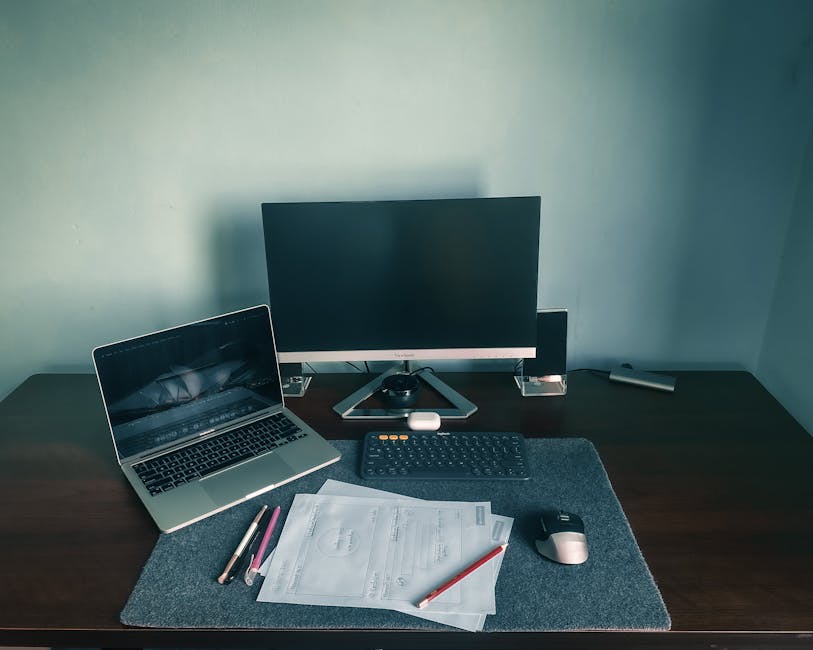 Image: Modern home office setup featuring a laptop, monitor, keyboard, and papers on a sleek desk.
Popular productivity apps include Todoist for task management, Freedom for blocking distractions, and Forest for gamified focus. Communication tools like Slack and Zoom are also essential.
How do I balance work and childcare effectively?
Balancing work and childcare requires setting boundaries, creating a kid zone, establishing routines, and communicating with your children about your work. Leverage nap times and quiet times for focused work.
How can I stay motivated when working from home?
Stay motivated by setting goals, celebrating small wins, taking regular breaks, connecting with colleagues, and creating a dedicated workspace.
What are the tax deductions available for home office expenses?
In many regions, you can deduct expenses related to your home office, such as rent, utilities, and office supplies. Consult with a tax professional for specific guidance.
How do I create a dedicated workspace in a small apartment?
Maximize space by using vertical storage, multi-functional furniture, and a folding desk. Choose a quiet corner and create a defined boundary with screens or curtains.
Conclusion: Crafting Your Perfect Home Office Brew
Recap of Key Strategies for a Productive Home Office
This guide has covered key strategies for creating a killer home office, including optimizing space, investing in the right technology, kid-proofing your workspace, integrating breaks, and maintaining long-term sustainability.